
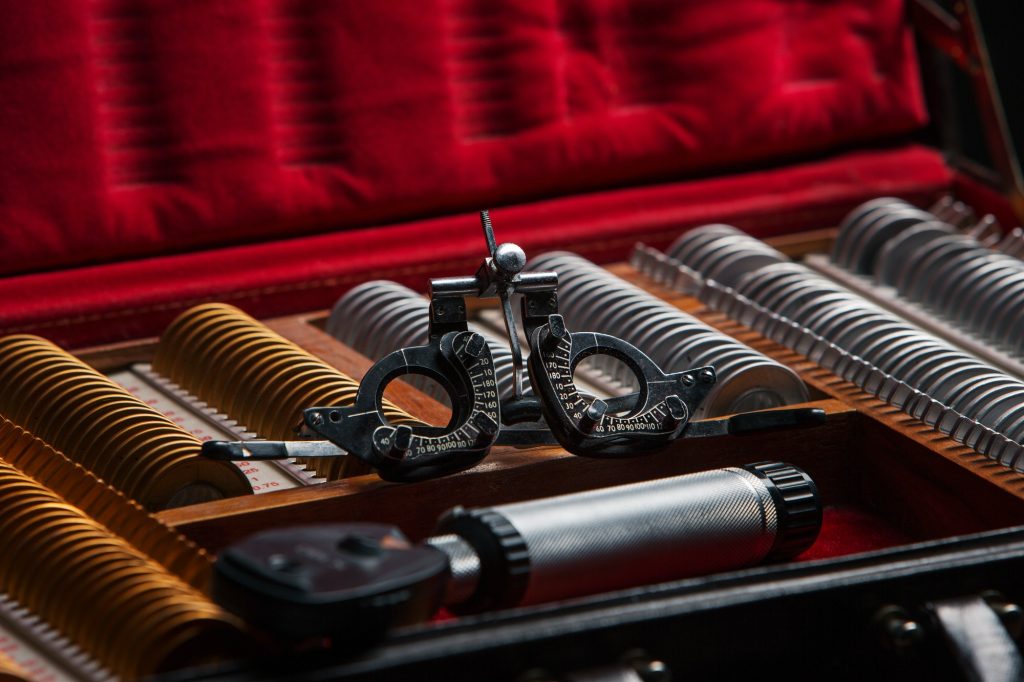
“You have a cylindrical power.” Many people hear that sentence at the end of an eye test and go home worried. It sounds like a diagnosis. It is not one. Cylindrical power is simply the part of a glasses prescription that corrects astigmatism, and astigmatism is one of the most ordinary findings in an eye examination.
What cylindrical power actually is
A perfectly regular eye is curved like a football: the same in every direction. Most eyes are not quite like that. The cornea, the clear window at the front of the eye, or sometimes the lens inside it, is a little steeper in one direction than the other, more like the back of a spoon or a rugby ball. Light passing through is focused at two slightly different points instead of one, and the image is smeared in one direction. That is astigmatism.
A spherical lens cannot fix this, because it has the same power all the way round. A cylindrical lens has power in one direction only, so it can add focusing exactly where the eye is short of it. On a prescription this appears as two values that always travel together:
- CYL, the cylindrical power in dioptres, written in steps of 0.25. It may be written with a minus or a plus sign; the two are different ways of noting the same lens.
- AXIS, a number from 1 to 180 that tells the laboratory which way to turn the cylinder. It is a direction, not a strength.
If the spherical part of a prescription is new to you as well, our article on whether an eyeglass grade is too high covers how the whole prescription is read.
Is cylindrical power harmful?
No. The number on the paper is a measurement of the shape of your eye, and the lens made from it is a correction. Neither harms the eye. Astigmatism is a refractive error, in the same family as short sight and long sight. It is not an eye disease and it does not by itself lead to blindness.
What can cause trouble is leaving a meaningful amount of astigmatism uncorrected. Typical complaints are:
- vision that is slightly blurred or shadowed at every distance, far and near
- letters that seem to have a ghost edge, or lines that look sharper in one direction than another
- tired eyes and headaches after reading, screen work or driving
- squinting, and more glare from headlights at night
These are problems of comfort and clarity. In an adult they go away when the correction is worn, and nothing is damaged by having gone without it.
How much is a lot?
There is no official line, but eye care professionals tend to describe cylinder roughly as follows.
| Cylinder (plus or minus) | Usual description | What it tends to mean in practice |
|---|---|---|
| 0.25 to 0.75 | Mild | Very common. Often noticed only as tired eyes, or not at all. |
| 1.00 to 2.00 | Moderate | Blur is usually noticeable without glasses. Correction is normally worn full time. |
| Above about 2.00 to 3.00 | High | Clear vision depends on an accurate correction and a careful fitting. |
Can you ignore it?
Sometimes, and it should be the examiner’s decision, not a guess. For an adult with a cylinder of 0.25 or 0.50 and no symptoms, optometrists often leave it out of the glasses, or do not prescribe glasses at all.
Once the cylinder is large enough to blur your vision or tire your eyes, ignoring it means putting up with those symptoms. If you drive, it is also a safety matter, particularly at night.
Children are the exception to “no harm done”. A young child’s visual system is still developing, and it learns to see from the image it is given. If one or both eyes send a blurred image for years because of uncorrected astigmatism, the brain may never learn to see sharply with that eye, a condition called amblyopia or lazy eye. It can be treated if found early, and it is much harder to treat later. For that reason, a child who is prescribed glasses for astigmatism should wear them as advised, and children should have their eyes examined even when they do not complain.
What causes it, and does it change?
In most people it is simply the shape of the eye they were born with, and it often runs in families. It is not caused by reading in poor light, by sitting close to the television or by using a phone.
For most adults the amount stays fairly steady for decades. Small shifts of a quarter or half a dioptre between tests are normal, and the direction of the astigmatism tends to drift slowly in later life. Cataract, eye surgery or an injury can also change it.
The pattern worth acting on is a cylinder that rises quickly, especially in a teenager or young adult, or vision that cannot be made sharp even with new glasses. This can be a sign of keratoconus, a condition in which the cornea gradually thins and bulges. It is uncommon, but it is treatable, and treatment works best when it starts early. An optometrist who suspects it will refer you to an ophthalmologist for a corneal scan. Habitual hard eye rubbing is linked with keratoconus, so it is a habit worth breaking.
How it is corrected
- Glasses. The simplest and most precise option. A new or changed cylinder can make floors look sloped and door frames look tilted for a few days. That normally settles within a week or two of full-time wear. If it does not, go back and have the glasses checked.
- Toric contact lenses. Soft lenses made with a cylinder and designed to stay the right way up on the eye. They need a proper fitting, because a lens that rotates blurs the vision. There is a wide choice of toric contact lenses for astigmatism in daily and monthly types.
- Surgery. Laser refractive surgery can reduce astigmatism in suitable adults, and people having cataract surgery can ask about lens implants that correct it. Suitability is for an ophthalmologist to decide.
Eye exercises, diets and eye drops do not change the shape of the cornea and will not reduce a cylinder.
When to have it checked
Book an eye test if you have blur or headaches that glasses used to solve, if your child squints, tilts their head or sits very close to things, or if it has been more than two years since your last test. In Abu Dhabi, you can book a free eye test with an optometrist at Optic One, and any licensed optometrist can measure astigmatism in a routine examination. Sudden changes in vision, pain or a red eye need a doctor promptly, not a routine appointment.
Common questions
Is minus 0.5 cylindrical power harmful?
No. A cylinder of 0.50 is mild. Many adults with that amount see comfortably without correcting it, and wearing or not wearing it will not damage the eyes.
Can we ignore cylindrical power?
A small cylinder with no symptoms can often be left uncorrected in an adult, if your optometrist agrees. Larger amounts, and any amount prescribed for a child, should be worn as advised.
Can I reduce my cylindrical power?
Not with exercises, food or drops. Glasses and contact lenses correct it while you wear them, and surgery can reduce it in suitable adults.
Does cylindrical power increase with age?
Usually only a little. It is fairly stable through adult life, with small changes over the years. A fast increase should be examined.
This article is general information and not a substitute for an eye examination. Your optometrist or eye doctor is the right person to decide what your own prescription needs.